
Table of Contents
Introduction: The Code You’re Embarrassed to Show
Imagine opening a WordPress plugin you wrote six months ago. You need to add a simple feature, but you’re greeted by a maze of global variables, scattered database calls, and classes so tightly coupled that changing one line breaks three others. Sound familiar?
You’re not alone. For years, WordPress developers have been taught to code by “tearing apart themes” and copying patterns that work, but don’t scale. The result? Code that’s impossible to test, painful to maintain, and embarrassing to show other developers.
Today, that changes. You’re about to learn Dependency Injection (DI), the single pattern that separates WordPress hackers from professional software architects. And no, it’s not as scary as it sounds.
What is Dependency Injection?
Dependency Injection is simply the practice of giving an object everything it needs to do its job, rather than letting it hunt for resources on its own.
The Coffee Shop Analogy
Imagine you walk into a coffee shop and order a latte.
The WordPress “Global” Way
Instead of paying normally, you hand the barista your entire wallet. The barista opens it, looks through everything, finds your credit card, and charges you. Along the way, they can also see your cash, your ID, and anything else you keep in there.
Did the barista need all of that?
No. They only needed one thing: a way to pay.
This is how global variables work in WordPress.
When a class uses globals, it gets access to far more information than it actually needs. That extra access makes the code harder to understand, harder to test, and easier to break by accident.

The Dependency Injection Way
Now imagine a better approach:
You hand the barista just your credit card. They swipe it, give it back, and your coffee is ready. No digging. No unnecessary access. No confusion. This is Dependency Injection.
Instead of a class reaching out to grab global data, you give it exactly what it needs at the start. Nothing more, nothing less.
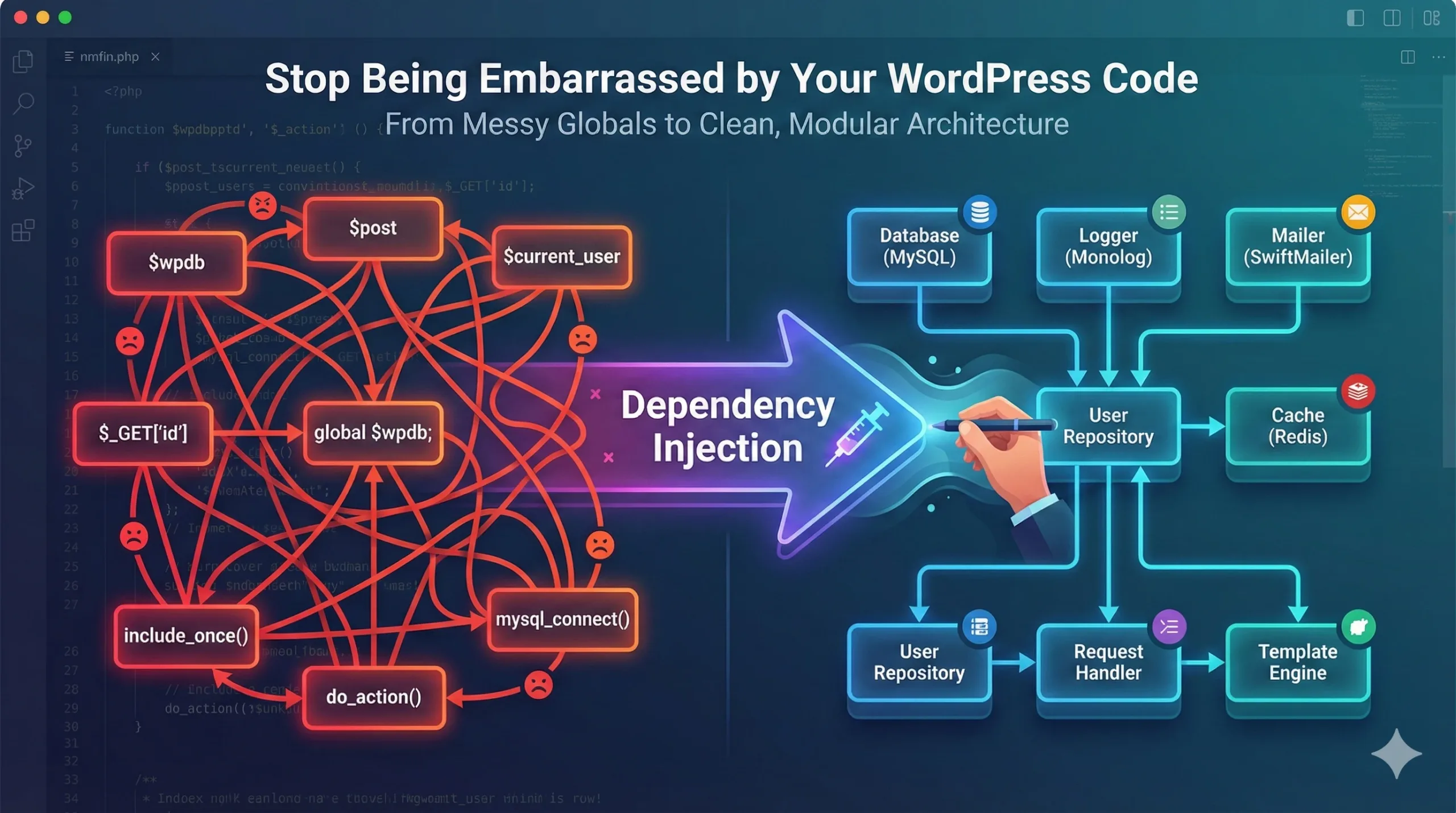
The Hidden Cost of WordPress Globals
If you learned WordPress by following tutorials, you’ve probably written code like this a thousand times:
global $wpdb;
global $current_user;
global $post;
Here’s the problem: this pattern creates what software architects call “tight coupling.” Your code becomes superglue to WordPress. Three devastating consequences:
- Impossible to Test: Try running your code in a test environment without loading the entire WordPress CMS. Spoiler: it crashes immediately.
- Impossible to Reuse: Want to use that clever function in a different project? Good luck extracting it from the tangled web of global dependencies.
- Impossible to Debug: When something breaks, you have to trace through layers of code to find out which global variable was modified where. It’s like debugging with a blindfold.
Let’s look at a real example: a class that saves post data to a custom database table.
The Old Way: Tightly Coupled (Bad)
class PostSaver {
    public function save_data( $data ) {
        // Reaching into global scope
        global $wpdb;

        // This class is now MARRIED to WordPress
        $wpdb->insert(
            $wpdb->prefix . 'my_table',
            $data
        );
    }
}
Why This is Terrible:
- The dependency on
$wpdbis hidden. You can’t tell from looking at the class signature. - Testing requires loading WordPress (slow, brittle, painful).
- You can’t swap the database without rewriting the entire class.
The New Way: Dependency Injection (Good)
class PostSaver {
    protected $db;

    // Crystal clear: this class needs a database
    public function __construct( wpdb $database ) {
        $this->db = $database;
    }

    public function save_data( $data ) {
        // Using the injected dependency
        $this->db->insert(
            $this->db->prefix . 'my_table',
            $data
        );
    }
}

// Usage: Inject the dependency when creating the object
$saver = new PostSaver( $wpdb );
$saver->save_data( $my_data );
Why This is Beautiful: The class signature tells you exactly what it needs. No surprises. No hidden globals. Just honest, self-documenting code.
The 3 Life-Changing Benefits of Dependency Injection
1. Testability: Write Tests in Milliseconds, Not Hours
This is the holy grail. With the old approach, testing PostSaver means:
- Spinning up a WordPress installation
- Connecting to a real database
- Running slow, fragile integration tests that break when your Wi-Fi hiccups
With Dependency Injection, you create a “mock” database object – a fake that looks like $wpdb but doesn’t touch any real data:
// In your test
$mock_db = $this->createMock( wpdb::class );
$saver = new PostSaver( $mock_db );
Your tests run in milliseconds. They never fail because of external dependencies. You can run them anywhere, anytime, even on a plane with no internet.
2. Flexibility: Swap Components Like LEGO Blocks
Imagine six months from now, your client says: “We need to save this data to an external API instead of the database.”
With tight coupling, you’re rewriting PostSaver from scratch. With Dependency Injection, you create a new class that implements the same interface:
$api_saver = new ApiDataSaver();
$saver = new PostSaver( $api_saver );
You changed the entire data layer without touching PostSaver‘s code. This is what developers mean by “loosely coupled.”
3. Self-Documenting Code: No More Archaeological Expeditions
Have you ever opened a 500-line file and spent 20 minutes hunting for which global variables were used where?
With Constructor Injection, your class screams its dependencies at the top:
public function __construct(
    wpdb $database,
    MailerInterface $mailer,
    LoggerInterface $logger
) { ... }
Any developer can look at this signature and instantly understand: “This class needs a database, a mailer, and a logger.” No surprises. No hidden dependencies lurking.
Dependency Injection isn’t just a coding pattern – it’s a professional mindset.
It’s the difference between:
- Code that works vs. code that lasts
- Hacking things together vs. architecting systems
- Junior developer vs. senior engineer
Yes, it requires more upfront thinking. Yes, it feels slower at first. But here’s what you gain:
– Code you can test in seconds, not hours
– Systems you can extend without fear
– Confidence that your code won’t explode in production
– The respect of developers who review your pull requests
– A portfolio you’re proud to show
The WordPress ecosystem is evolving. Modern frameworks like Roots Sage already use Dependency Injection by default. Gutenberg uses React patterns that embrace component composition. The future of WordPress development is professional, tested, architected code.
“If you’re struggling with tight coupling, follow our 30-day guide to building a Dependency Injection mindset.”
Leave a Reply